Mar
Disclaimer: This article is for educational and informational purposes only and does not constitute medical advice. Always consult with a qualified healthcare professional before beginning any new medication protocol or combining treatments.
When researching advanced anti-parasitic protocols, acquiring high-quality compounds is only half the battle. The most common reason these protocols fail is not the medication itself—it is a lack of systemic absorption.
If you are diving into broad-spectrum parasite eradication, you have likely encountered the term “binder” or “lipid carrier.” Both Ivermectin and Fenbendazole (as well as its premium human-grade alternative, Mebendazole) require a specific delivery method to work effectively.
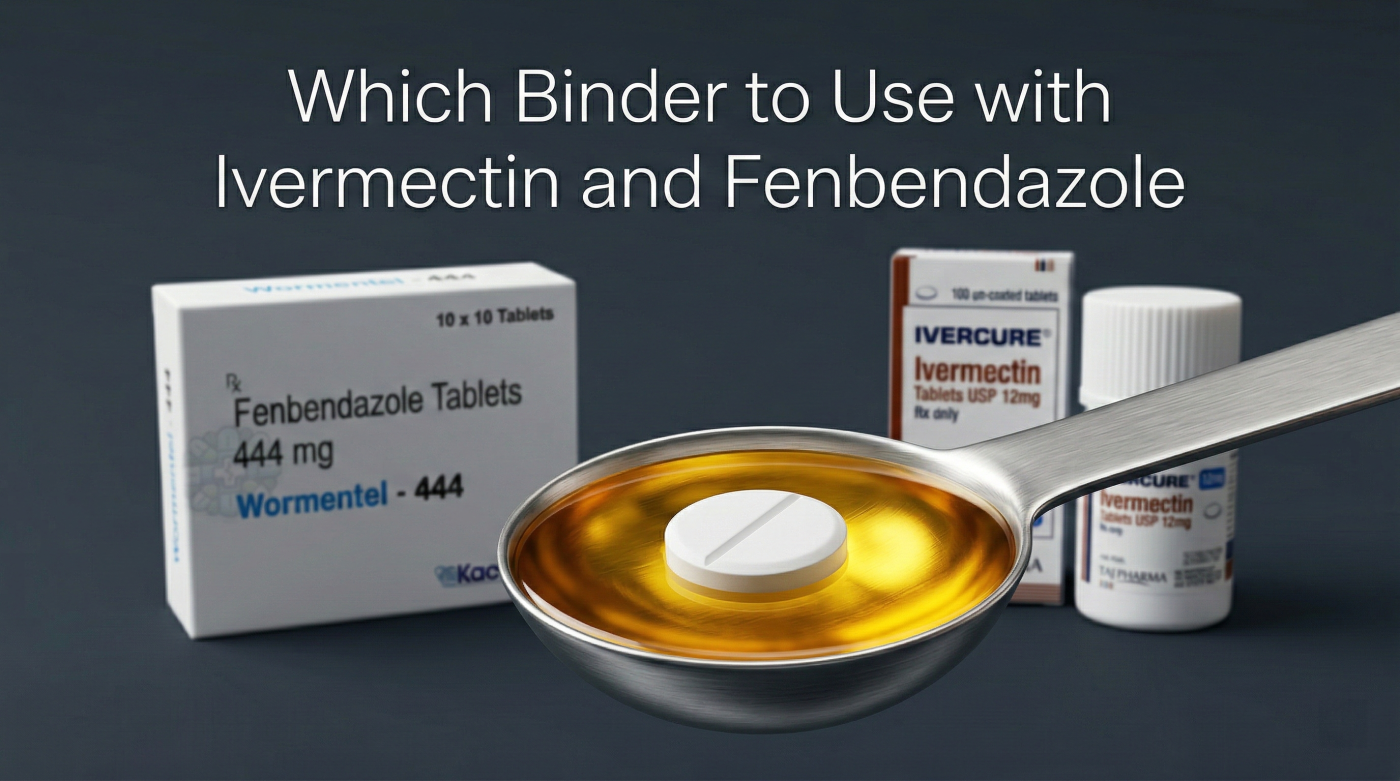
If you are wondering exactly which binder to use with Ivermectin and Fenbendazole, you are asking the right question. In this guide, we break down the science of absorption, the top binders to use, and where to source pure medications for your protocol.
Learn more Ivermectin and Fenbendazole…
Why Do You Need a Binder in the First Place?
To understand why a binder is non-negotiable, you must understand the chemical nature of these anthelmintic (anti-parasitic) medications.
Both Ivermectin and Fenbendazole are highly lipophilic. In simple terms, this means they dissolve in fats, not in water.
If you take these medications on a completely empty stomach with just a glass of water, the active pharmaceutical ingredients will struggle to pass through the intestinal wall. Instead of entering your bloodstream to target tissue-dwelling parasites or systemic infections, a massive percentage of the medication will simply be flushed out through your digestive tract unabsorbed.
A “binder” acts as a lipid (fat) vehicle. It binds to the medication, bypassing standard water-based digestion, and pulls the active ingredients directly across the intestinal barrier and into your system for maximum bioavailability.
Which Binder to Use with Ivermectin and Fenbendazole?
For the highest rate of systemic absorption, you need a pure, easily digestible fat source. Here are the top three binders utilized in advanced protocols:
1. MCT Oil (Medium-Chain Triglycerides) – The Gold Standard

MCT oil is widely considered the ultimate lipid carrier for lipophilic medications. Unlike long-chain fats, MCTs are broken down rapidly and absorbed directly into the portal vein, heading straight to the liver. Taking your medication with a tablespoon of high-quality MCT oil ensures rapid, highly efficient systemic delivery.
2. Omega-3 Fish Oil

If MCT oil is too harsh on your stomach, Omega-3 fish oil is a highly regarded alternative. It provides the necessary heavy fats to bind to the active pharmaceutical ingredients while offering the added benefit of being a natural anti-inflammatory—which is highly beneficial when the body is dealing with parasitic die-off.
3. Extra Virgin Olive Oil or a High-Fat Meal

If specialized carrier oils are not available, you can still achieve excellent bioavailability using household fats. Taking your dose with a tablespoon of extra virgin olive oil, a glass of whole milk, or immediately following a heavy, fat-rich meal (like eggs and avocado) will drastically outperform taking it on an empty stomach.
Quality Matters: Pairing Binders with Pure Medications
Optimizing your absorption with the perfect binder is useless if the medication you are taking is under-dosed, degraded, or full of toxic fillers.
The online market is currently saturated with unverified, anonymous vendors selling questionable anti-parasitic tablets. To ensure your protocol is safe and effective, you must pair your lipid binders with pure, pharmaceutical-grade medications from a trusted global pharmacy.
At GenixMeds, we provide lab-tested, accurately dosed, life-saving medications with secure worldwide delivery.
Sourcing Your Protocol at GenixMeds:
1. Premium Ivermectin Options: For the neurological disruption phase of your protocol, we stock the world’s most trusted brands:
-
Ivermectin Iverotaj-12: A highly reliable, pure 12mg dose.
-
Ivercure 12 (Ivermectin 12mg): Formulated for optimal systemic breakdown.
-
Ivermectin 12 mg Iverheal: Our pharmaceutical-grade global best-seller.

2. The Human-Grade Metabolic Disruptor: If you are building a human protocol and researching Fenbendazole, medical professionals widely recommend its human-grade chemical cousin: Mebendazole. Operating via the exact same cellular starvation mechanism, Mebendazole is the premium standard for human use.
-
Mebendazole 500mg (Menditaj): A powerful 500mg dose designed specifically for comprehensive parasite clearance. (Note: Because it is in the same chemical family, Mebendazole also requires a lipid binder like MCT oil for maximum absorption).
Conclusion
Understanding which binder to use with Ivermectin and Fenbendazole is the secret to unlocking the full potential of your anti-parasitic protocol. Because these medications are fat-soluble, utilizing a high-quality lipid carrier like MCT oil or Omega-3s is critical for pushing the active ingredients into your bloodstream. By pairing this knowledge with pure, securely sourced medications from GenixMeds, you ensure a safe, highly effective, and deeply comprehensive eradication protocol.